
NewsDetails
CYZ Self-Priming Centrifugal Oil Pump — Marine Fuel Transfer and Emergency Oil Pumping
author:Tianyi Pump time:2026-07-23 11:48:44 Click:99
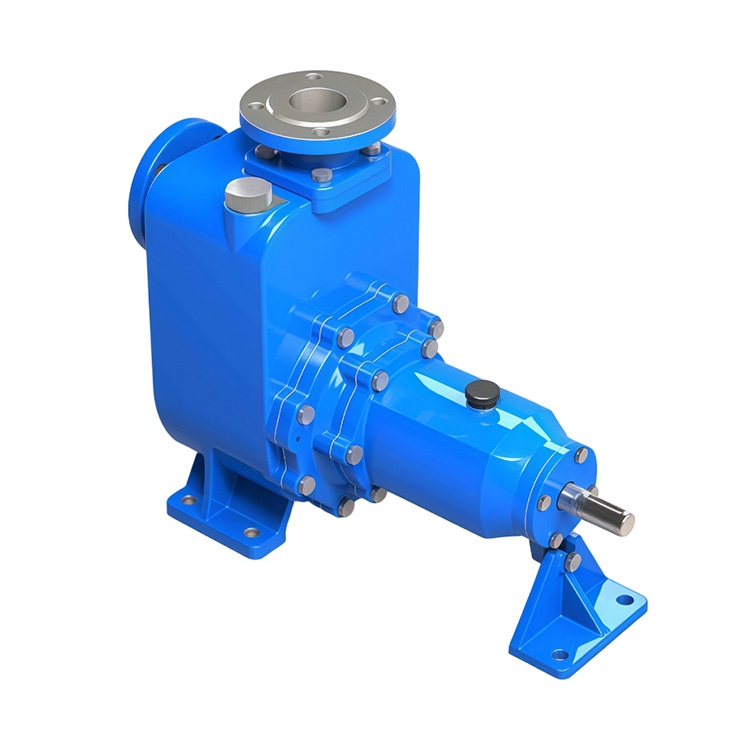
When a pump must handle clean petroleum products and draw fluid from below its centerline without manual priming, the CYZ series self-priming centrifugal oil pump is a common and trusted choice. It combines the simple construction and high flow rates of a centrifugal pump with the convenience of automatic self-priming. Widely used on ships, at oil depots, and in emergency oil transfer situations, the CYZ series delivers exactly what operators need — straightforward, maintainable pumping for diesel, fuel oil, and light lubricants.
How Self-Priming Works in the CYZ Series
A standard centrifugal pump cannot create suction on its own — if the casing is filled with air, the impeller merely churns it without drawing liquid. The CYZ series overcomes this through two design features. First, the pump casing is specially shaped to retain liquid inside the volute even after stopping. This retained charge acts as a sealing and priming medium. Second, a separation chamber removes air from the recirculating liquid and expels it through the discharge. During priming, the impeller circulates the retained liquid mixed with air. The mixture enters the separation chamber where air is released and forced out while liquid falls back to the impeller inlet. This cycle repeats until all air in the suction pipe is evacuated. Once primed, the pump operates as a standard centrifugal pump. The process is automatic and typically completes within minutes.
Key Advantages of the CYZ Design
Compared with positive displacement pumps, the CYZ delivers higher flow rates for a given physical size, making it more compact for high-volume transfer. The centrifugal impeller handles small quantities of entrained gas without losing prime — useful when suction lines intermittently draw air. Maintenance is straightforward with only one rotating assembly — the impeller and shaft — versus the intermeshing rotors of gear or screw pumps. The split-case design allows the upper casing half to be removed for impeller inspection without disturbing piping connections. The self-priming capability itself is the defining advantage — the pump can be installed above the liquid level, saving floor space and eliminating the need for foot valves or vacuum priming systems.
Marine and Offshore Applications
Marine engineering is a primary application area. Ships need reliable pumps for fuel oil transfer from storage to day tanks, diesel transfer to generators, and bilge pumping where self-priming is essential. The CYZ's compact footprint and intermittent-duty capability suit engine room environments. On smaller vessels, one CYZ pump often serves multiple fuel functions through a manifold arrangement. On offshore platforms where space is limited, the pump can be installed on an upper deck while drawing fuel from tanks below, eliminating submerged pump installations that are harder to service.
Fuel Transfer and Oil Depot Operations
At distribution terminals, the CYZ pump is common for truck loading, tank-to-tank transfer, and fuel forwarding. High flow rates reduce transfer times during peak hours. The pump handles diesel, gasoline, kerosene, and light fuel oils — heavier fuels require appropriate seals and possibly heating jackets. In emergency oil transfer, the CYZ's self-priming feature is critical. Response teams can deploy the pump quickly with only suction and discharge hoses, and it primes automatically once started. This simplicity is valuable in time-sensitive spill response operations.
Installation Considerations
Although self-priming, the CYZ's priming performance depends heavily on proper installation. The pump must be mounted as close to the fluid source as practical to minimize suction line length and friction losses.
Although self-priming, the CYZ's priming performance depends on installation. Suction lift should not exceed the manufacturer's rated maximum, typically 4-6 meters. Suction pipe diameter must be adequate, and the pipe should slope upward toward the pump to prevent air pockets. All suction joints must be airtight — any vacuum leak prevents priming or causes prime loss during operation. A check valve at the bottom of the suction line helps maintain prime when the pump is stopped. Without one, the pump re-primes on each startup. For hazardous locations, explosion-proof motor configurations should be specified.
Selecting the Right Model
The correct CYZ model depends on required flow rate, discharge head, and fluid type. The pump manufacturer should confirm material compatibility — particularly for gasoline or low-viscosity, high-vapor-pressure fuels where seal selection is critical. With proper selection and installation, the CYZ self-priming centrifugal pump provides a practical, low-maintenance solution for oil transfer across a wide range of industrial and marine applications.
References
Karassik, I. J., Messina, J. P., Cooper, P., & Heald, C. C. (2001). Pump Handbook (4th ed.). McGraw-Hill.
Nesbitt, B. (2006). Handbook of Pumps and Pumping. Elsevier.
Bloch, H. P., & Budris, A. R. (2013). Pump User's Handbook: Life Extension (4th ed.). Fairmont Press.
Brennen, C. E. (1994). Hydrodynamics of Pumps. Cambridge University Press.
International Maritime Organization. (2012). IMO Guidelines for Marine Fuel Systems. IMO Publishing.
 Recommended Products
 Contact us
—— Contact:Mr. Shi
—— Tel:+86 15612730683
—— Email:btclyb@163.com
—— Url:https://www.tianyi-pump.com
—— Address:260 meters east of Xiaoquan Village Committee, Bozhen, Botou City, Cangzhou City, Hebei Province